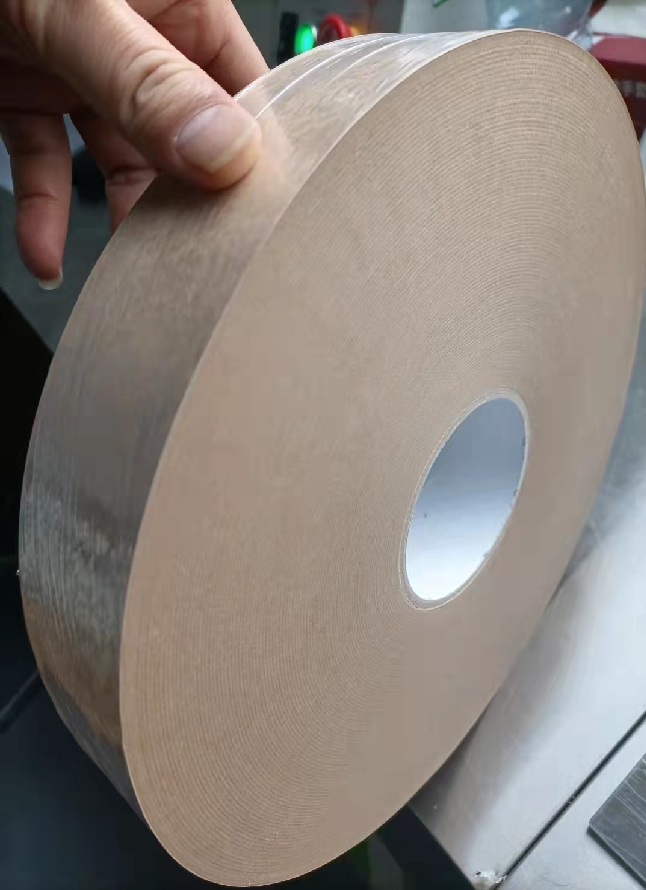
Self-adhesive laminated hot melt gummed paper tape has become an indispensable part of the modern packaging industry due to its environmental characteristics and excellent performance.
This tape uses kraft paper as the base material and is manufactured through precise processes such as PE lamination and hot melt adhesive coating.
It not only possesses high strength and tear resistance but also is significantly more environmentally friendly than traditional plastic tapes.
With the global enhancement of environmental awareness, the market demand for sustainable packaging materials has surged sharply.
Self-adhesive laminated hot melt gummed paper tape is gaining broader application fields thanks to its biodegradable and recyclable properties.
Suzhou Zhongming New Material Technology Co., Ltd. is a professional manufacturer specializing in the research, development, and production of kraft paper tapes. We will systematically introduce the production process of this product, delving into the technical points and process controls of each stage, from raw material preparation to final slitting and packaging.
1. Selection and Preparation of Raw Materials
The quality of the kraft paper base material directly determines the final performance of the tape.
Typically, high-quality kraft paper weighing 60-120 g/m² is selected.
It requires uniform fiber structure, high bursting strength, and balanced longitudinal and transverse tension to withstand significant pulling force and pressure without breaking.
The tightness of the base material is controlled at about 0.8.
One side is a rough surface for adhesive coating, and the other side is a bright surface for lamination treatment.
This structural design ensures a firm bond between the adhesive layer and the base material.
Lamination Materials
The laminating materials mainly use polyethylene (PE) or degradable polymers.
Traditional PE lamination provides excellent waterproof performance, while emerging degradable materials (such as Polylactic Acid, PLA) offer superior environmental advantages, as they can decompose under natural conditions, reducing environmental pollution.
The choice of laminating material requires comprehensive consideration of product use, environmental requirements, and cost factors.
Hot Melt Adhesive Formula
The formula of the hot melt adhesive is the core of the tape's performance.
The basic composition includes: thermoplastic elastomer (25-35%), softening oil (15-25%), resin (40-50%), and antioxidant (1-3%).
This formula balances initial tack and holding power, ensuring the tape forms a persistent adhesive force at room temperature. Environmentally friendly hot melt adhesives using plant- based raw materials further enhance the product's sustainability.
2. Base Material and Lamination
Before processing, the kraft paper base material requires pretreatment, including static elimination and humidity adjustment, to ensure the quality of subsequent processing.
The electrostatic treatment voltage is usually controlled at 5-15 kV, which not only enhances the composite strength of the material but also improves production safety.
The lamination process is carried out under high-temperature conditions, where molten PE plastic particles are uniformly coated onto the surface of the kraft paper through an extruder. The lamination thickness is precisely controlled between 0.01-0.02 mm, forming a dense waterproof layer.
The laminated kraft paper then needs to be cured and set through a cooling roller system.
The cooling temperature is controlled between 15-25°C to ensure uniform crystallization of the laminated layer and avoid internal stress generation.
The surface of the set laminated layer should be smooth and even, free of bubbles, fish eyes, and other defects, laying the foundation for subsequent silicone coating.
3. Release Treatment and Solvent-free Silicone Coating
Release treatment is required on the surface of the laminated layer, which involves coating solvent-free silicone oil to form a release layer.
Solvent-free silicone coating is applied using gravure coating or doctor blade coating methods, with the coating amount precisely controlled between 0.8-1.2 g/m².
The purpose of the solvent-free silicone layer is to prevent the tape from sticking during winding, ensuring smooth unwinding.
After silicone coating, it needs to be cured in an oven, with the temperature typically set between 100-130°C for 30-60 seconds.
This process cross-links the silicone oil to form a stable release film.
The release force is controlled between 10-20 g/25mm, ensuring good release effect without affecting the subsequent use of the tape.
For high-performance products, a calendering layer might be added on top of the silicone layer.
Calendering treatment improves the smoothness and gloss of the kraft paper surface, increasing the paper's surface density, which not only enhances waterproof performance but also improves printing clarity.
4. Hot Melt Adhesive Preparation and Coating Technology
The preparation of the hot melt adhesive takes place in a sealed glue tank.
Thermoplastic elastomer, softening oil, resin, and antioxidant are mixed according to the formula ratio, then heated and stirred above 105°C until the raw materials are completely melted into liquid glue.
The heating temperature must be precisely controlled; too high can cause glue degradation, while too low affects the full compatibility between components.
After preparation, the glue is precisely coated onto the rough surface of the release paper through automated coating equipment.
Coating methods can be doctor blade, roller coating, or spray coating, adjusting the coating thickness according to product requirements, typically controlled at 20-80 g/m².
The environment must be kept clean during coating to prevent impurities from affecting tape quality.
After coating, the material immediately enters a drying system with segmented temperature settings: initial setting at 60-80°C in the front section, enhanced curing at 100-120°C in the middle section, and cooling to room temperature in the rear section.
The entire drying process can occur in a closed air duct or at low temperatures, ensuring full solvent volatilization and uniform curing of the adhesive layer.
5. Compounding and Curing
For structurally enhanced kraft paper tape, it might be necessary to add a reinforcement layer (like fiberglass mesh or non-woven fabric) or a composite reinforcement layer between two layers of kraft paper base material.
The reinforcement materials are usually bonded tightly to the kraft paper base with degradable adhesive, significantly improving the tape's tensile strength and toughness.
The compounding process occurs under precisely controlled temperature and pressure:
hot-press temperature maintained at 80-120°C, pressure at 0.3-0.6 MPa, for 2-5 seconds.
These parameters ensure a firm bond between layers, avoiding delamination or blistering.
After compounding, the tape requires curing—placed in a constant temperature and humidity environment for 24-48 hours—allowing the molecular chains of the hot melt adhesive to fully relax and cross-link, achieving stable bonding performance.
The curing environment temperature is controlled at 25±2°C with relative humidity at 50±5%.
6. Slitting and Packaging
After the master roll is cured, high-speed rewinding machines are used for slitting. Tension control during slitting is crucial, maintained between 15-25 N.
Too low tension causes loose rolls, while too high leads to tape deformation or breakage.
Slitting width is adjusted according to customer needs, common specifications include 12mm, 24mm, 36mm, 48mm, 50mm, 60mm, 72mm, etc.
High slitting precision is required, with width deviation controlled within ±0.3 mm, ensuring uniform product specifications.
Simultaneously, online quality inspection is conducted during slitting, automatically rejecting defective sections.
For tapes with special purposes, perforation (a process requiring specific equipment) might be needed.
The perforation spacing is usually 2-5 cm, with depth controlled to penetrate the tape base without damaging the release layer, allowing users to tear off as needed.
Slitted tapes are packaged according to specifications: small rolls in OPP bags or shrink film, large rolls directly in cartons.
Packaging materials need moisture-proof function to ensure stable product performance during storage and transportation.
7. Quality and Performance
Quality control for self-adhesive PE laminated hot melt gummed paper tape runs through the entire production process.
Raw materials require strict inspection before warehousing, including the tensile strength of the kraft paper, the viscosity of the hot melt adhesive, and the melt flow index of the laminating material.
In-process quality control points include: uniformity of PE lamination thickness, silicone coating weight, and precision of adhesive coating.
Samples are tested every half hour to ensure stable process parameters.
Online inspection systems monitor product surface quality in real-time, automatically marking defect locations.
Finished product performance tests mainly include the following aspects:
| Test Item | Standard | Method |
|---|---|---|
| Initial Tack | ≥ No. 8 steel ball | Inclined rolling ball method |
| Holding Power | ≥ 10-12 hours | Standard test conditions |
| Peel Strength | ≥ 0.4 KN/M | Tested on steel plate |
| Tensile Strength | ≥ 4 KN/M | Standard test |
Environmental performance tests include biodegradability and toxic substance content testing.
Biodegradable tape needs its decomposition rate tested under specific conditions, typically requiring ≥ 60% decomposition within 180 days.
8. Technology and Innovation
Technology for self-adhesive PE laminated hot melt gummed paper tape continues to innovate, with several important advancements emerging in recent years.
The patented three-layer composite structure (kraft paper base layer, hot melt adhesive layer, and a middle PE plastic film layer of 0.01-0.02mm thickness) improves the tape's anti-cracking performance by over 60%, with a tensile load reaching ≥400 N/75 cm.
Biodegradable technology is another important innovation direction.
Using dyed colored kraft paper as the base material, combined with a biodegradable polymer waterproof coating to form an isolation layer, eliminates the traditional lamination process, reducing processing thresholds and costs while meeting environmental requirements.
The application of intelligent manufacturing technology in tape production is becoming increasingly widespread.
Automated coating equipment equipped with PLC systems monitors and adjusts process parameters in real-time; online inspection systems use machine vision to automatically identify and mark product defects, greatly improving production efficiency and product consistency.
In the future, this tape will develop towards functionalization and intelligence.
Products like temperature-indicating tapes and RFID-integrated tapes will meet specific application needs, further enhancing added value.
Summarize
The production of self-adhesive laminated hot melt gummed paper tape is a systematic project involving multiple precise steps. Strict control of each process is crucial to the final product's performance.
With growing environmental demands and technological progress, this field will continue to innovate, providing greener and more efficient solutions for the packaging industry.
For professional R&D and manufacturing enterprises like us, only by continuously optimizing processes and improving product quality can we remain competitive in the increasingly fierce market.